Applications
Blast freezing for food production and handling
A blast freezer removes heat from incoming products more quickly than a storage freezer. The design must follow the product, package, batch arrangement, required final condition, and production schedule. Common applications include seafood, meat, poultry, bakery products, prepared food, ice cream, fruit, and vegetables.
Seafood, meat and poultry
Fish, shrimp, shellfish, cuts of meat, and poultry differ in shape, moisture, packaging, and loading method. These details affect heat removal and airflow around every batch.
Bakery and prepared food
Dough, bakery items, cooked products, and prepared meals require a layout that supports the production sequence, trolley or tray handling, and consistent air access to the product.
Ice cream, fruit and vegetables
Product formulation, package dimensions, initial temperature, and sensitivity to dehydration or surface damage should be reviewed before equipment and airflow are selected.
Freezing Performance
Factors that affect freezing performance
Freezing time cannot be selected from room temperature alone. It is the result of product properties, batch arrangement, heat transfer, available refrigeration capacity, and air movement. A useful quotation therefore starts with real production data.
Product type and thickness
Composition, shape, thickness, and packaging change how rapidly heat can move from the product to the surrounding air.
Batch loading capacity
Total batch weight, trolley or rack arrangement, spacing, and loading frequency define the heat entering the system.
Airflow and insulation
Air must reach product surfaces without uncontrolled bypass. Room panels, doors, floor details, and sealing also influence the load.
Initial and target condition
The initial product temperature, target product condition, and required processing time must be stated clearly and verified for the application.
System Components
A coordinated room, airflow and refrigeration package
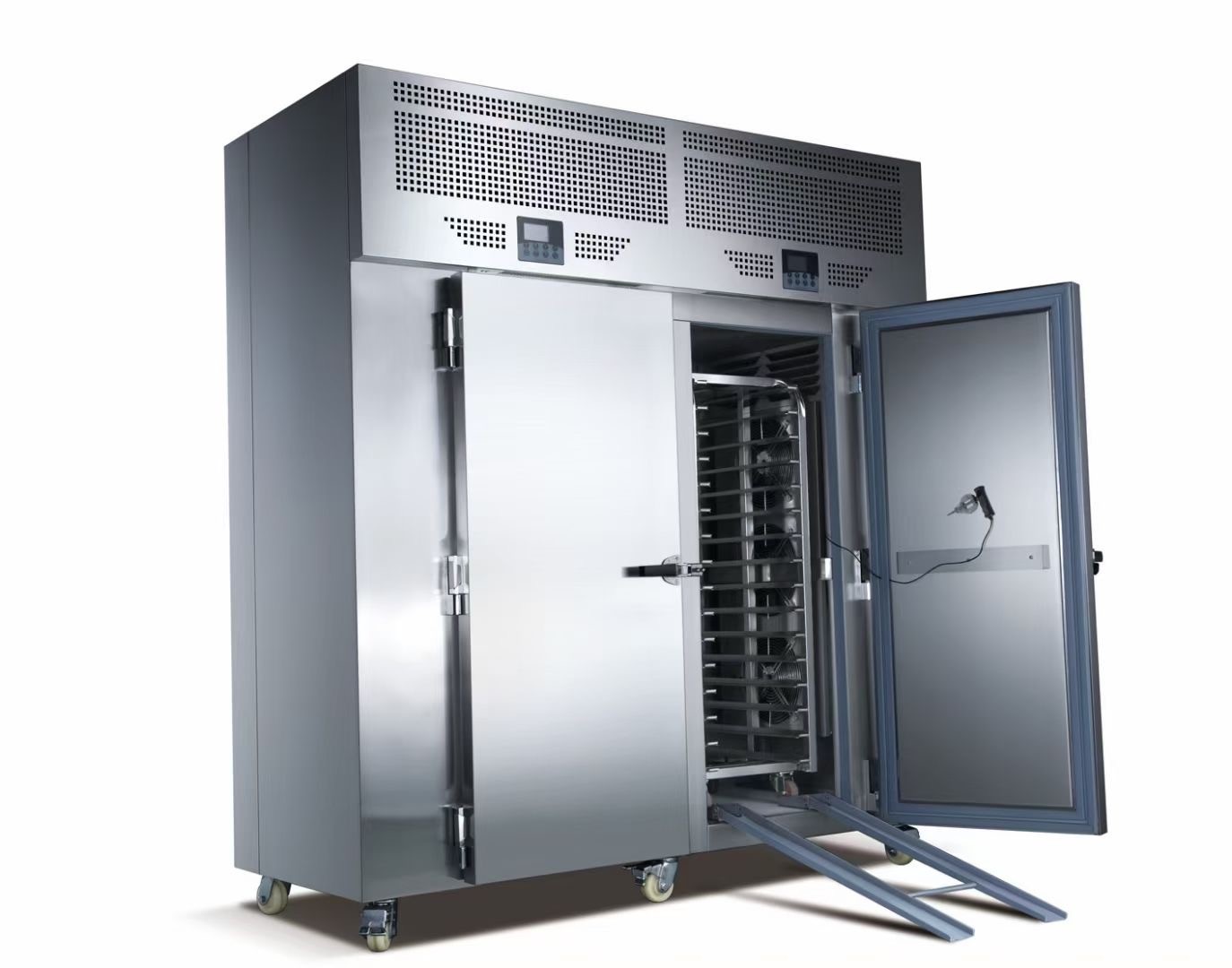
A blast freezer is more than a low-temperature room. The enclosure, evaporator, condensing equipment, controls, and product layout must work together. When the production requirement is clear, the equipment can be evaluated against the complete load.
For frozen storage after processing, a separate cold room or freezer room may be planned as part of the material flow.
Insulated room
Panels, floor construction, doors, sealing, and access are selected for the operating condition and handling process.
Evaporator and air circulation
The indoor heat exchanger and fan arrangement distribute cold air through the product load. Air path, product spacing, and return-air access are important.
Condensing unit
The condensing unit is matched to the calculated load, design conditions, refrigerant requirement, power supply, and installation environment.
Control panel
Controls coordinate temperature operation, fans, defrost, alarms, and system protection. Required recording or remote functions should be identified before quotation.
Product Handling
Plan loading and unloading with the air path
Product arrangement can either support or restrict heat transfer. Tray spacing, trolley position, carton openings, pallet layout, and the distance between the load and evaporator should be considered during room planning. The operating team also needs a repeatable loading procedure so different batches are placed consistently.
Door opening, product transfer, cleaning access, drainage, and the time between batches affect daily production. These details should be reviewed with the buyer before the final room layout is confirmed. Local food-safety and hygiene requirements remain the responsibility of the project owner and should be stated during design review.
How to Choose
Define the production target before selecting equipment
The supplier needs to understand how products enter and leave the freezer, whether they are placed on trays, racks, trolleys, or conveyors, and how much space is available around the load. Product dimensions and packaging often matter as much as total batch weight.
Any required freezing time should be treated as a project target for engineering review, not as a general promise. Product trials or validation may be needed where the process has strict core-temperature or quality requirements.
Information Required for Quotation
Share complete batch and site information
- Product type and packaging
- Batch capacity and number of batches per day
- Product dimensions, thickness, and loading arrangement
- Initial product temperature
- Target product temperature or condition
- Required freezing time for engineering review
- Installation location and available power supply
Contact our team with these details for a project-specific discussion.
Related Products
Equipment for freezing and cold storage
FAQ
Blast freezer buyer questions
How is a blast freezer different from a storage freezer?
A blast freezer is designed to remove heat rapidly from incoming products using stronger airflow and a system matched to the production load. A storage freezer mainly maintains products that are already frozen.
What determines the required freezing capacity?
Product type, total batch weight, product thickness, packaging, initial temperature, target condition, required processing time, and site conditions all contribute to capacity selection.
Can you confirm freezing time before receiving product information?
No reliable freezing-time estimate can be made without product and loading data. Strict process requirements may also require testing or validation by the buyer and engineering team.
Can the room be designed for racks or trolleys?
The internal layout, door position, evaporator location, and airflow path can be reviewed for the buyer’s specified racks, trays, or trolleys.
What power-supply information is needed?
Provide the available voltage, phase, and frequency at the installation site. Any local electrical or control requirements should also be stated.
What should be included in the quotation request?
Include product type, batch capacity, dimensions, loading arrangement, initial and target temperatures, desired freezing time, site location, ambient conditions, and power supply.