Suitable Applications
Fresh-air cooling for ventilated buildings
Evaporative air coolers are used where a building benefits from a continuous supply of outside air and can discharge warm indoor air. Suitable projects may include workshops, warehouses, factories, logistics centers, and selected commercial spaces. The result depends strongly on local climate, building ventilation, heat sources, and installation layout.
Workshops and factories
Production buildings with machinery, workers, open doors, or regular air exchange may use evaporative cooling to introduce fresh air and improve air movement in occupied zones.
Warehouses and logistics centers
Large storage and handling spaces often require careful air-distribution planning. Rack height, loading doors, roof heat, vehicle movement, and exhaust paths affect equipment quantity and duct layout.
Commercial and semi-open spaces
Markets, halls, agricultural facilities, and other ventilated spaces may be considered where local humidity and the required comfort level suit evaporative cooling.
How It Works
How evaporative cooling works
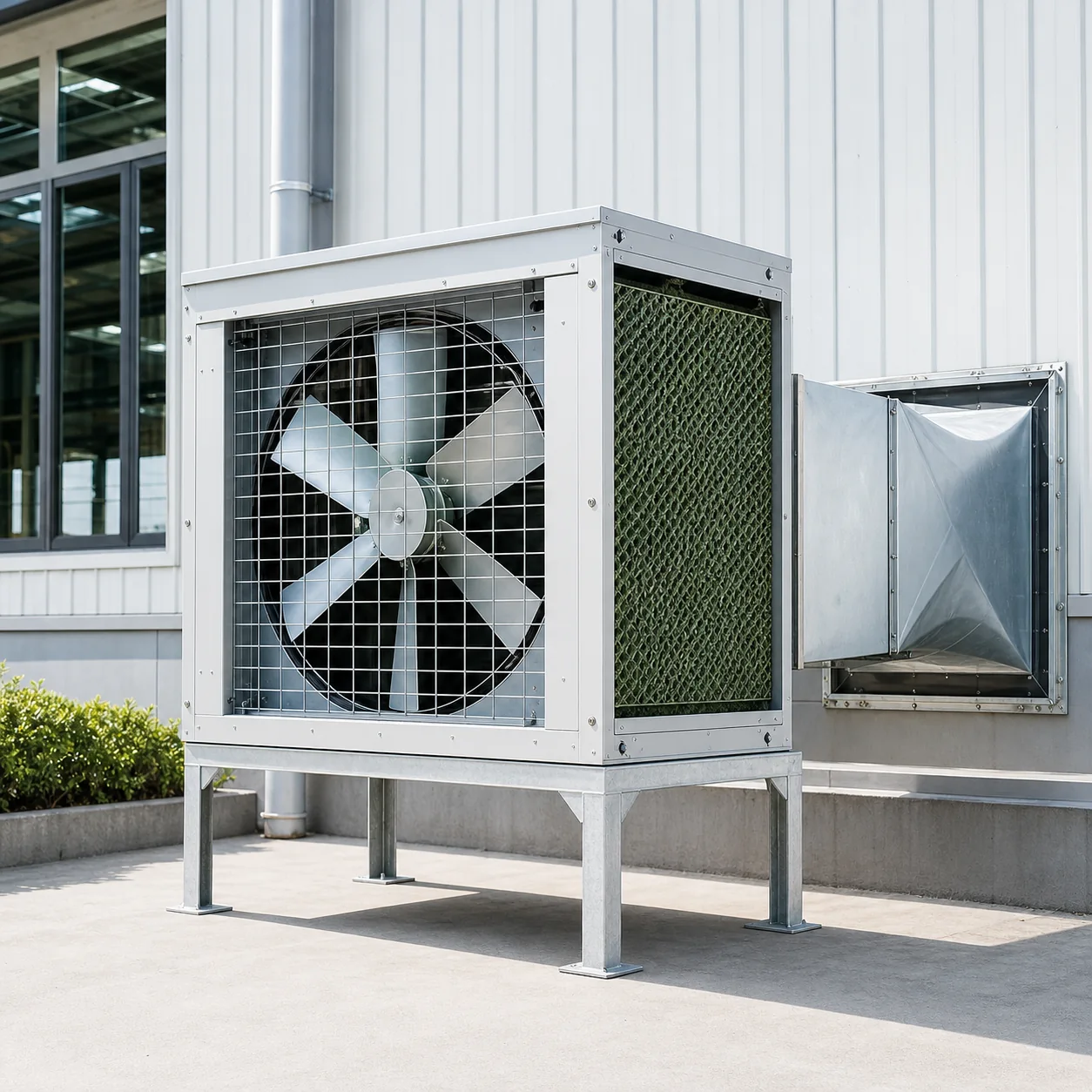
The unit draws outside air through wetted cooling media. As part of the water evaporates into the air stream, heat is absorbed and the supply air temperature is reduced. A fan then delivers this cooled fresh air into the building.
Because the process continually introduces outside air, the building needs a practical exhaust path through open doors, windows, louvers, roof vents, or designed extraction. Without adequate discharge, humidity and pressure can build up and reduce comfort.
Performance varies with outdoor dry-bulb temperature and humidity. Hotter, drier air generally provides more evaporative potential than humid air. Local climate data should therefore be checked before model selection.
Main planning points
- Fresh outside air enters through the cooling media
- Water evaporation absorbs heat from the air stream
- The fan distributes cooled air to occupied areas
- Warm indoor air must be able to leave the building
- Water quality and maintenance affect long-term operation
- Climate limits the achievable supply-air condition
System Comparison
Evaporative air cooler vs refrigeration air conditioner
These two systems serve different operating goals. Evaporative cooling is an open-air process suited to spaces with fresh-air demand and suitable climate. Refrigeration air conditioning is a closed-cycle system used when tighter indoor temperature and humidity control is required.
Evaporative air cooler
Uses water evaporation and outside air. It is typically considered for ventilated, open, or semi-open industrial and commercial spaces. It adds moisture to the air and cannot provide the same controlled indoor condition as a refrigeration system.
Its suitability depends on outdoor humidity, ventilation, water supply, and the required comfort target. Operating cost should be evaluated from the selected model and actual local conditions rather than a general percentage claim.
Refrigeration air conditioner
Uses a refrigeration cycle and normally recirculates or conditions indoor air. It is more appropriate where the buyer needs a defined indoor setpoint, dehumidification, or a more enclosed building.
For product storage rather than human comfort, a purpose-designed cold room should be evaluated instead of a comfort-cooling system.
Selection Factors
Plan airflow for the whole building
Airflow requirement should be assessed from building dimensions, occupied zones, internal heat sources, opening patterns, and the required air-change strategy. Unit position and duct direction should prevent short-circuiting between supply and exhaust.
Climate data matters because evaporative potential changes with temperature and humidity. The design should also confirm water availability, water quality, drainage, electrical supply, roof or wall structure, service access, and control method.
For very large or complex buildings, the buyer should provide a floor plan showing work zones, equipment heat sources, doors, windows, and proposed installation positions.
Maintenance planning should include regular inspection of cooling media, water distribution, filters, fan components, sump, drainage, and controls. The actual schedule depends on operating hours, dust level, local water quality, and manufacturer instructions for the selected model.
Noise expectations and the location of nearby offices, residences, or property boundaries should also be identified before the fan and installation arrangement are finalized.
Information Required for Quotation
Share building and utility information
- Building length, width, height, and floor plan
- Workshop, warehouse, factory, logistics, or commercial use
- Installation city and local climate conditions
- Existing ventilation and available exhaust openings
- Main indoor heat sources and occupied work areas
- Preferred wall, roof, or ducted installation position
- Available water supply, water quality, and drainage
- Available voltage, phase, and frequency
Contact our team with these details for a project review.
Related Products
Other BesCool cooling products
FAQ
Evaporative air cooler buyer questions
Is an evaporative air cooler the same as an air conditioner?
No. An evaporative cooler uses outside air and water evaporation. A refrigeration air conditioner uses a refrigeration cycle and can provide tighter control in an enclosed space.
Which climates are suitable for evaporative cooling?
Suitability depends on local temperature and humidity. Hot, dry conditions generally offer more evaporative cooling potential than humid conditions, so project climate data should be reviewed.
Does the building need exhaust openings?
Yes. The system supplies fresh air, so warm indoor air must have a controlled path to leave through openings, vents, louvers, or mechanical exhaust.
Can it be used in an enclosed temperature-controlled room?
Evaporative cooling is generally intended for ventilated spaces. If the project requires a precise indoor setpoint or product-storage condition, a refrigeration-based system should be evaluated.
What water information is required?
Confirm water availability, pressure, quality, drainage, and any local treatment or discharge requirements. Maintenance planning should reflect local water quality.
What should I provide for unit selection?
Provide building dimensions, use, climate, heat sources, ventilation, installation position, water and drainage details, electrical supply, and a floor plan where available.